Free ChatGPT Alternatives That Are Just as Good (or Better)
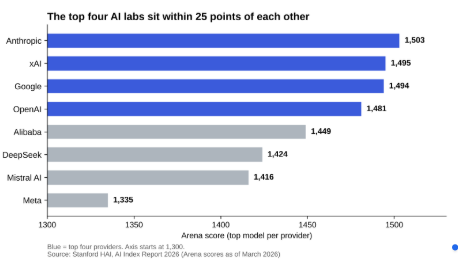
Twenty-two points. That was the distance between the best Anthropic model and the best OpenAI model on the Arena leaderboard in March 2026, according to Stanford’s AI Index Report 2026. Arena ranks models through blind head-to-head votes, and under standard Elo math, a 22-point lead means people would pick the leader’s answer about 53 times out of 100. That’s a coin toss with a slight lean.
So when someone says a free tool can match ChatGPT, they’re not dreaming anymore. They are usually skipping one detail that changes the whole comparison, though. Below is what the numbers actually show, which free tools hold up in November 2026, and a quick way to test them on your own work before you switch anything.
The Quality Gap Between Top AI Labs Has Nearly Closed
Stanford’s 2026 report found that the top four model makers sat within 25 points of each other on Arena as of March 2026. A year earlier, the same top four spanned roughly 97 points. That’s a lot of squeezing in twelve months.
Open-weight models, the kind DeepSeek and Alibaba release and let you use for free, trail a little more. The best closed model in the report (Claude Opus 4.6, 1,503) led the best open one (GLM-5, 1,454) by 49 points. Plug that into the same Elo formula and you get roughly a 57 to 43 preference split. You’d notice it over a week of use. It’s still not a different league.
Free Plans Usually Run the Smaller Model
Now the catch. Those leaderboard numbers describe each company’s flagship model. Free plans almost never hand you the flagship.
- ChatGPT Free runs GPT-5.6 Luna, the smallest model in OpenAI’s GPT-5.6 family, and OpenAI’s help center says ads may appear on the Free tier in certain countries.
- Gemini without a paid plan defaults to Auto, which sends most prompts to Flash-Lite and only some to Flash or Pro (Google Gemini Help, October 2026).
- Claude Free includes Sonnet 5.5 and Haiku 5.5, not Opus (AIMLAPI plan comparison, November 11, 2026).
So the fair fight isn’t free Claude against paid ChatGPT. It’s free against free. And on that footing, ChatGPT Free is one compact model with separate caps on tools like uploads and data analysis. Several alternatives give you more for the same zero dollars, at least for specific jobs.
Five Free ChatGPT Alternatives Worth Opening Today
I read through the top-ranking roundups for this topic, then checked the plan details they lean on. Most lists run 10 to 30 tools long. You don’t need 30 tabs. These five cover nearly every everyday task.
| Tool | What the free plan gives you | Best for | Watch for |
| Claude Free | Sonnet 5.5 and Haiku 5.5, file uploads, web search, up to five Projects | Long-form writing and careful editing | Rolling five-hour usage window |
| Gemini | Auto model selection (mostly Flash-Lite), Canvas, Deep Research | Gmail and Google Docs users | 32K-token context on free |
| Microsoft Copilot | Copilot chat on the web and in Windows | Quick drafts and everyday questions | Limits aren’t published |
| Perplexity | Practically unlimited basic searches, 3 Pro Searches a day | Research with clickable sources | 1 Research query a month |
| DeepSeek | Chat with DeepThink and Search modes | Reasoning, math and code | Login required; no published cap |
Plan details come from AIMLAPI (checked November 11, 2026) and Elephas (re-checked October 14, 2026). Free limits change often, so glance at each plan page before you commit.
Claude for writing you’ll actually publish
If your main job is words, start here. Claude’s free plan gets you Sonnet 5.5, which handles tone, structure and long documents well. The trade-off is the five-hour usage window. Heavy days can run you into it by lunch.
Gemini if you live inside Google’s apps
Gemini earns its spot through integration more than raw brains. It works across Gmail and Docs, and Canvas is handy for drafting. Just know that since October 2026, most free prompts go to Flash-Lite, which is built for speed rather than depth.
Perplexity when every claim needs a source
Perplexity answers with citations you can click and check. For research, that habit of showing its work is the main reason to use it over a general chatbot. Save its single monthly Research query for something that matters.
DeepSeek and Copilot for everything in between
DeepSeek is the best-known open-weight lab with a free chat app, with no published message cap when Elephas checked in October. Copilot is the low-friction pick if you’re already on Windows or Edge.
For Writers: A Free Draft-and-Clean Setup
General chatbots are built to answer questions. Writers usually need something narrower: a draft that sounds like a person wrote it. Phrasly approaches that with two pieces. Phrasly Neo is a chatbot free for signed-in users with daily limits, and free plans can write documents up to 500 words beside the chat.
When a draft comes back stiff or full of leftover formatting, Phrasly’s cleanup tool takes it from there. Easy mode makes minimal changes, Medium balances flow and cleanup, and Aggressive rewrites more heavily. The free plan handles up to 2,500 words at a time, 10 times a day. For anyone who writes more than they research, that pairing is the free ChatGPT alternative I’d try first. One honest note: Phrasly’s own page says it can make mistakes, so read the result before you send it.
Where Free Alternatives Win, and Where They Slip
The wins are mostly about specialization. Claude writes cleaner long-form prose, Perplexity cites, Gemini plugs into your inbox. ChatGPT Free tries to do all of it with one small model, and in some countries it now shows ads too.
The slips are about precision. When AIMLAPI ran three free plans through the same tasks in November 2026, Claude scored 5 out of 5 on a writing task but got every page number wrong by one when pulling data from a PDF. Gemini couldn’t read a CSV file and worked from the chart instead. The page numbers had to be fixed by hand.
That pattern holds across free tiers. Smaller models are great with words and shakier with exact details like page numbers, figures, dates and names. Use them for drafting and thinking. Double-check them on anything you’d be embarrassed to get wrong.
How to Test a Free Alternative in 20 Minutes
Reviews can’t tell you how a tool handles your work. A short side-by-side test can.
- Pick three real tasks from last week, such as an email, a summary and a research question.
- Run the exact same prompt in ChatGPT Free and two alternatives.
- Paste the answers into one document without labels and pick your favorite blind, the same way Arena voters do.
- Check every fact, figure and name in the winning answers. Phrasly’s guide to tools that cut editing time without losing brand voice has a useful list of what to verify after any AI edit.
- Note where each tool hit a limit or asked you to upgrade.
- Keep the winner for that type of task, not for everything.
You’ll probably end up with two free tools instead of one paid one. That’s normal. Very few people need a single assistant that does it all.
Choose by Task, Not by Brand
The 2026 numbers make one thing clear. At the top end, the big AI labs are close enough that brand loyalty matters less than it did even a year ago. What separates the free plans now is fit: which model you actually get, what it caps, and what it’s built to do.
So skip the hunt for one perfect replacement. Use Claude when the writing has to be good, Perplexity when the facts have to be traceable, Gemini when your work lives in Google’s apps, and a writing-first setup like Phrasly when the draft needs to sound like you. Test them on real tasks, check the details, and keep the $20 a month for something else.