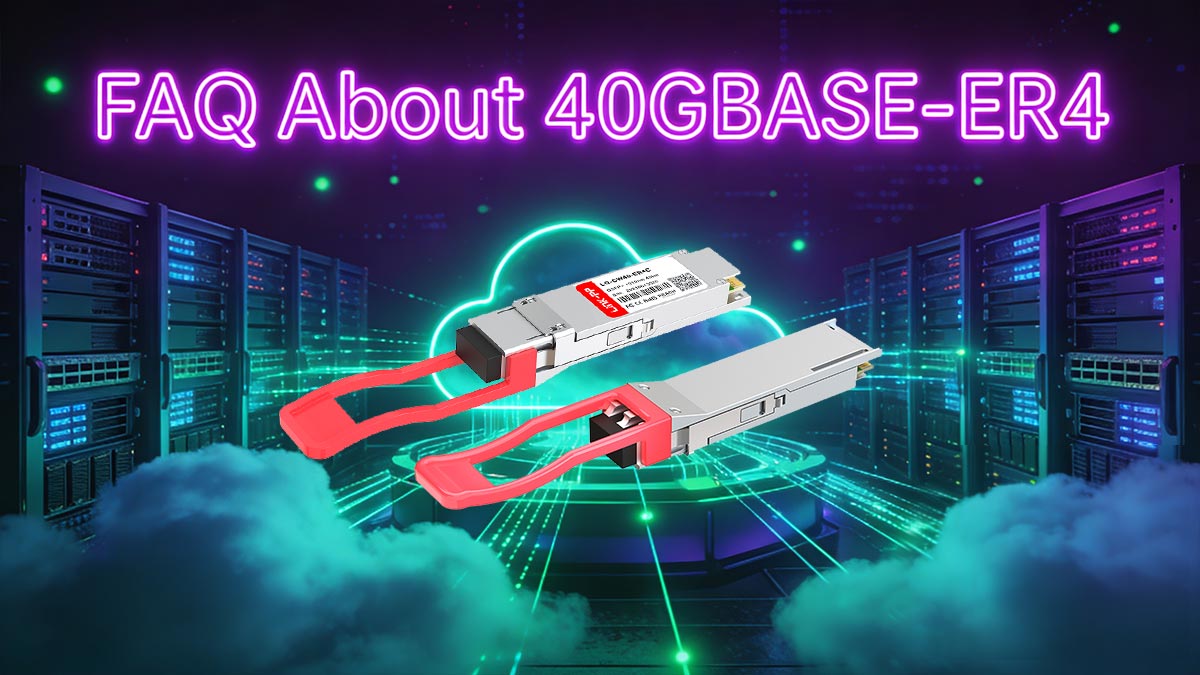
40GBASE-LR4 from a Migration Perspective: Bridging the Gap Between Old and New Networks
Most Networks Evolve in Stages, Not in One Big Upgrade
When people imagine network modernization, they often picture a complete transformation—new switches, new optics, higher speeds everywhere. But in real-world deployments, infrastructure rarely changes all at once.
Networks usually evolve in layers.
Some systems are upgraded early because they handle critical workloads. Others stay in place much longer because they still perform adequately. Budget cycles, hardware lifespans, and operational risk all affect how quickly changes happen.
This creates transitional periods where old and new technologies need to coexist.
And that’s exactly where 40GBASE-LR4 tends to become valuable.
Defined under the IEEE 802.3 specification, 40GBASE-LR4 supports 40Gbps transmission over duplex single-mode fiber up to approximately 10 kilometers. It sits between legacy 10G infrastructure and newer 100G environments, making it a natural bridge technology during phased upgrades.
Why Jumping Directly to 100G Isn’t Always Practical
From a technical standpoint, moving directly from 10G to 100G sounds efficient. But infrastructure decisions are rarely based on bandwidth alone.
Higher-speed upgrades often involve additional costs beyond the optics themselves. Switch hardware may need replacement, power and cooling requirements can increase, and operational teams may need time to adapt to new architectures.
In some environments, those changes happen too quickly to manage comfortably.
40GBASE-LR4 reduces that pressure.
Instead of forcing an immediate leap, it provides an intermediate layer that significantly increases capacity while maintaining compatibility with many existing systems. This allows organizations to relieve bandwidth bottlenecks without fully committing to a next-generation redesign right away.
For many teams, that flexibility matters more than theoretical peak performance.
A Smooth Transition for Existing Fiber Infrastructure
Another reason LR4 works well during migrations is that it aligns with infrastructure already in place.
Many enterprise and campus environments already rely heavily on single-mode fiber for inter-building or inter-floor connections. Replacing that fiber would add unnecessary cost and disruption.
40GBASE-LR4 continues using the same duplex single-mode architecture.
That means the upgrade focuses mainly on the endpoints—switch ports and modules—rather than the cabling system itself. Existing fiber paths, patch panels, and routing structures remain usable.
This greatly simplifies the migration process.
Instead of rebuilding the physical layer, teams can gradually improve bandwidth using the infrastructure they already trust.
Maintaining Operational Familiarity During Upgrades
Large technology transitions often fail not because the technology is bad, but because the operational changes become difficult to manage.
New systems introduce new workflows, monitoring requirements, and troubleshooting methods. During a migration phase, adding too much complexity too quickly increases operational risk.
40GBASE-LR4 avoids much of that issue because it behaves like familiar Ethernet infrastructure.
Deployment remains straightforward. Monitoring tools continue reporting standard interface statistics and optical diagnostics. Troubleshooting procedures remain largely unchanged.
For operations teams, this consistency is important.
It allows upgrades to happen without forcing the organization to relearn how the network behaves overnight.
Supporting Mixed-Speed Environments
One reality of phased migration is that networks temporarily become mixed environments.
Some links remain at 10G. Others move to 40G. Core layers may already be operating at 100G while edge infrastructure lags behind. During these periods, interoperability and stability become more important than maximum performance.
40GBASE-LR4 fits naturally into this layered structure.
It provides enough bandwidth to relieve congestion between legacy and modern segments while remaining manageable within both environments. It doesn’t force every connected system to upgrade simultaneously.
That flexibility reduces the risk of creating isolated performance bottlenecks during the transition.
What Deployment Looks Like in Practice
From a practical standpoint, deploying LR4 modules is usually uncomplicated.
The QSFP+ module is inserted into the switch, duplex LC single-mode fiber is connected, and the link is established. Internally, the module multiplexes four separate 10G wavelengths to create the 40G connection, but operationally, that complexity stays hidden from the user.
Most deployment challenges still come from physical layer considerations—fiber cleanliness, connector quality, and link loss budgets. These are familiar concerns that network teams already know how to manage.
Once installed correctly, LR4 links tend to remain stable for long periods.
That reliability is especially valuable during migration phases, where minimizing unexpected behavior becomes a priority.
Why Some Networks Stay in This “Middle Stage” Longer Than Expected
Interestingly, many organizations discover that the intermediate stage lasts much longer than originally planned.
A network upgraded to 40G may continue meeting performance needs for years. Traffic growth may slow, workloads may stabilize, or budgets may shift toward other priorities.
As long as the infrastructure performs reliably, there’s often little urgency to move beyond it immediately.
This is one reason 40GBASE-LR4 remains widely deployed even as newer technologies continue to emerge.
It solves practical problems well enough that replacement can wait.
Conclusion
40GBASE-LR4 serves as an effective bridge technology for organizations transitioning between legacy 10G infrastructure and higher-speed modern networks. By providing a substantial bandwidth increase while maintaining compatibility with existing single-mode fiber systems and familiar Ethernet operations, it enables gradual migration without forcing immediate large-scale redesigns. In environments where upgrades happen incrementally rather than all at once, LR4 offers a stable and practical path forward that balances performance growth with operational continuity.
Stay in touch to get more updates & news on Tamil Print!