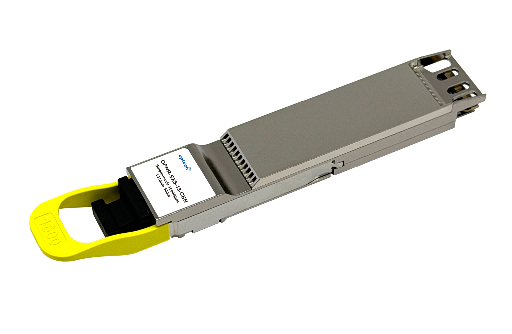
How Does a 1.6T DR8 OSFP224 Transceiver Support Next-Generation AI Networks?
AI workloads are placing growing demands on data center networks. Large language models, generative AI applications, and high-performance computing clusters require rapid data exchange between GPUs, servers, and switches. As these workloads scale, traditional network speeds can become a limitation for data-intensive operations. 1.6T OSFP224 modules provide up to 1.6 Tbps of aggregate bandwidth per module, helping network designers accommodate increasing traffic demands and build higher-capacity interconnects for next-generation AI infrastructure.
Beyond raw bandwidth, the design of an optical transceiver affects port density, fiber connectivity, and the overall architecture of a data center network. A 1.6T DR8 OSFP224 transceiver combines a high-speed OSFP224 form factor with eight optical lanes to support high-capacity data transmission over single-mode fiber. With a nominal wavelength of 1310 nm and a transmission distance of up to 500 meters, this type of module is intended for short- to medium-reach optical links within suitable data center environments.
Understanding how a 1.6T DR8 OSFP224 transceiver works helps network engineers evaluate its role in AI clusters, high-density Ethernet switching, and data center upgrades. Its benefits depend not only on the module’s bandwidth but also on electrical lane configuration, optical interfaces, switch compatibility, and the requirements of the intended network topology.
Why Do AI Networks Need 1.6T Optical Transceivers?
AI training and inference involve frequent data exchanges among accelerators and between compute nodes. During distributed model training, GPUs must synchronize parameters and exchange intermediate results across the network. As the number of accelerators increases, east-west traffic between servers can grow substantially, placing greater pressure on switch capacity and interconnect bandwidth.
Higher-speed optical transceivers help address this demand by increasing the bandwidth available through individual switch ports. Compared with an equivalent number of lower-speed ports, a 1.6T interface can provide greater aggregate capacity while potentially reducing the number of physical connections required for a given bandwidth target. The actual benefits depend on switch architecture, supported port configurations, oversubscription, and the design of the surrounding network.
Optical connectivity is particularly useful when links extend beyond the practical reach of direct-attach copper cables or when fiber is preferred for cabling flexibility and electromagnetic immunity. In AI data centers, these characteristics make high-speed optical transceivers an important component of scalable Ethernet fabrics.
How Does a 1.6T DR8 OSFP224 Transceiver Work?
Understanding the DR8 Optical Architecture
DR8 describes an eight-lane, single-mode optical transmission architecture. In a typical 1.6T implementation using eight lanes operating at approximately 200 Gb/s each, the aggregate nominal line rate reaches 1.6 Tbps. Each lane carries part of the total traffic, allowing the module to deliver high bandwidth through a single transceiver assembly.
The module uses parallel optical transmission rather than relying on a single optical channel to carry the entire data rate. Electrical signals from the host switch are converted into optical signals for transmission over fiber, while the receiving side converts incoming optical signals back into electrical signals. This conversion enables high-speed communication between network devices while supporting the bandwidth requirements of modern AI infrastructure.
The Role of PAM4 and 1310nm Wavelength
PAM4, or four-level pulse-amplitude modulation, encodes two bits per symbol by using four distinct signal levels. Compared with binary NRZ signaling, PAM4 can carry more bits per symbol at a similar symbol rate. This makes it a practical signaling technology for high-speed optical interfaces, although it also introduces stricter signal-quality requirements and can require advanced digital signal processing.
A nominal operating wavelength of 1310 nm is commonly used in single-mode data center optics. Single-mode fiber supports optical transmission with low modal dispersion, making it suitable for links where bandwidth and distance requirements exceed those of many multimode applications. For a 1.6T DR8 transceiver rated for up to 500 meters, the specified reach should be evaluated alongside fiber type, connector loss, patching, and the module’s optical power budget.
Why Is the OSFP224 Form Factor Important?
OSFP224 is designed for high-speed optical connectivity using an electrical interface associated with 224G-class signaling. Its form factor supports the integration of high-bandwidth optical engines and the thermal management requirements associated with advanced transceivers. As data rates increase, maintaining signal integrity and removing heat become important considerations for both module manufacturers and switch designers.
The OSFP224 form factor is relevant to network platforms designed for 1.6T connectivity, but the form factor alone does not guarantee compatibility with every switch. Engineers must confirm the switch’s supported module type, port configuration, firmware requirements, and thermal specifications before deployment. Mechanical fit, electrical interface support, and host-side configuration all contribute to successful operation.
How Do Dual MPO-12/APC Interfaces Support Fiber Connectivity?
MPO connectors consolidate multiple optical fiber connections into a compact interface, helping simplify cabling in high-density switching environments. A dual MPO-12/APC configuration provides two MPO connector interfaces, with APC referring to angled physical contact at the connector end face. This design can support organized parallel-fiber connections while reducing the space required for individual fiber connectors.
However, the presence of two MPO-12 connectors does not, by itself, establish the exact fiber mapping or the number of active fibers. The optical lane assignment, transmit and receive paths, and use of individual fibers must be verified against the manufacturer’s specification and connection diagram. Correct polarity and compatible mating interfaces are also essential for establishing a working optical link.
For installations using single-mode fiber, technicians should inspect connector end faces, follow appropriate cleaning procedures, and verify the polarity of the complete channel. These checks help prevent avoidable insertion loss and connectivity problems during commissioning.
What Should You Check Before Deploying a 1.6T DR8 Transceiver?
Switch Compatibility and Thermal Requirements
When selecting a 1.6T DR8 OSFP224 transceiver for an AI network, engineers should first verify that the target switch supports the specific module configuration. For NVIDIA Spectrum-6 SN6600-LD liquid-cooled switches, compatibility should be confirmed using the applicable platform documentation and validated module information. Liquid cooling at the system level does not eliminate the need to follow the switch manufacturer’s requirements for module power consumption, airflow around optical components, and thermal operating limits.
Host configuration and software support also matter. Firmware recognition, supported link modes, port breakout options, and diagnostic monitoring capabilities should be checked before a large-scale rollout. Digital diagnostics monitoring, when supported by the module and host, can help operators observe parameters such as temperature, supply voltage, and optical transmit or receive power.
Fiber Infrastructure and Link Validation
A 500-meter reach rating does not mean every installed fiber channel will automatically support the link. Engineers should confirm the required single-mode fiber specification, total channel loss, connector compatibility, and the suitability of patch panels and intermediate connections. Testing the completed link and checking optical diagnostics can help identify problems before the network enters production.
Conclusion
A 1.6T DR8 OSFP224 transceiver supports next-generation AI networks by combining high aggregate bandwidth, parallel single-mode optical transmission, PAM4 signaling, and a form factor designed for advanced high-speed switching platforms. Its 1310 nm operating wavelength and specified 500-meter reach make it relevant to suitable data center interconnect applications.
Successful deployment, however, depends on more than the headline data rate. Switch compatibility, thermal requirements, MPO connectivity, fiber polarity, and end-to-end link validation must all be considered. By evaluating these factors together, network engineers can determine whether a 1.6T DR8 OSFP224 solution fits their AI infrastructure and supports their longer-term capacity requirements.