Wall Mounted Folding Tables for Residential Utility Rooms With Limited Clearance and Multipurpose Needs
A utility room that has to handle laundry, ironing, pet care, and storage rarely has room for a permanent work surface. A wall mounted folding table solves that conflict: it gives you a full-size worktop when you need one and returns the floor space the moment you fold it flat against the wall.
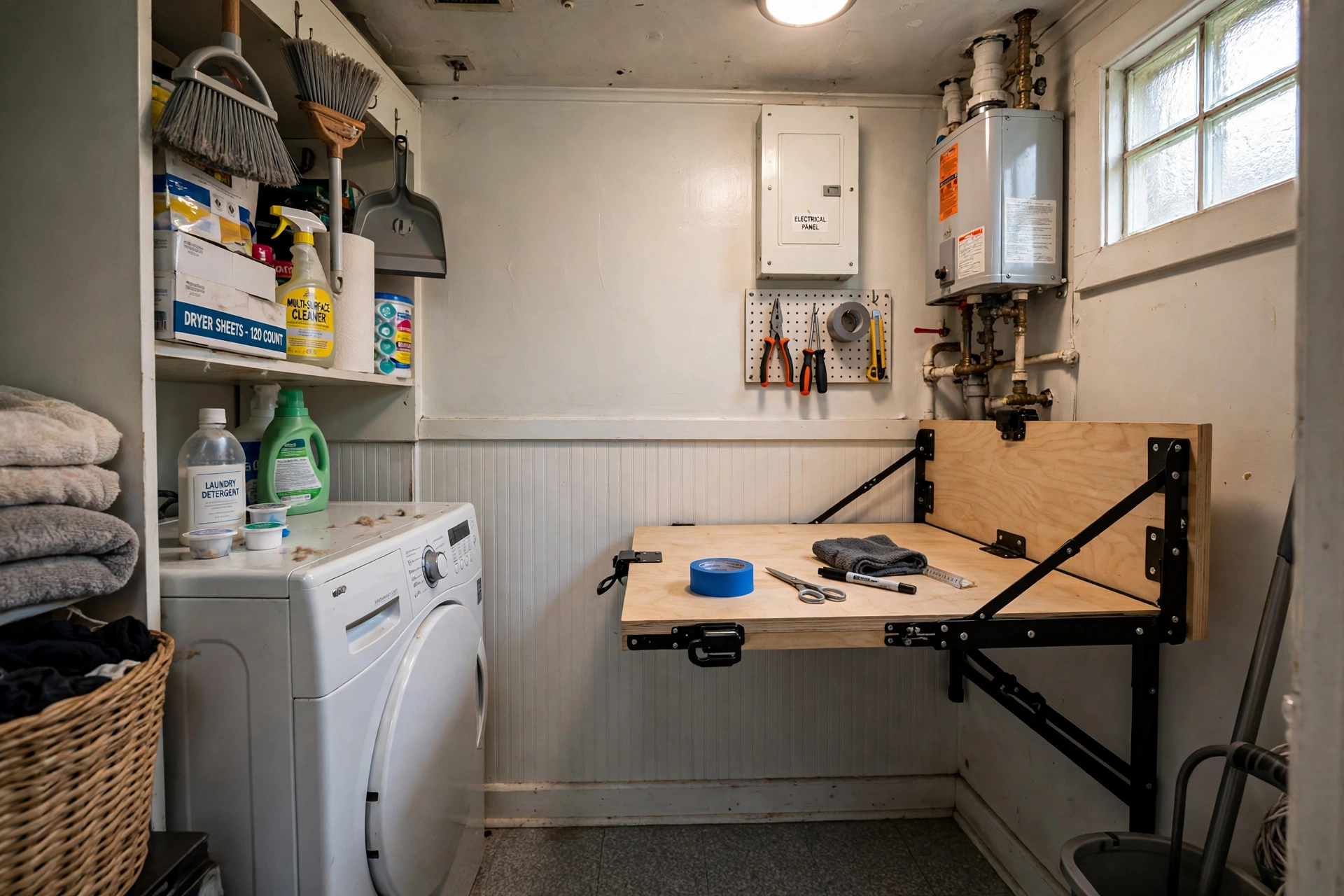
In short, a wall mounted folding table is a tabletop hinged to the wall and held level by folding brackets, gas struts, or support arms. Folded down, it works as a laundry folding station, an ironing surface, a sorting counter, or a small workbench. Folded up, it takes up roughly two inches of depth.
Why a Fold-Down Surface Beats a Fixed Counter in a Cramped Utility Room
A fixed counter in a small utility room creates a permanent obstacle. It blocks access to shut-off valves, steals the swing space a washer door needs, and turns a narrow walkway into a squeeze. A fold-down table avoids all three problems because it only exists while it is being used. When laundry is done, the room goes back to being a passage or a drying area.
Utility rooms also change jobs through the week: Monday's folding station becomes Saturday's potting bench or the place where a pet gets brushed. A wall mounted table adapts because it carries no fixed purpose.
Mapping Your Utility Room's Dead Wall Space Before You Buy
Before comparing products, spend ten minutes studying the room. The right wall is usually the one that is not already doing a job: no electrical panel, no water heater access, no door swing, and no appliance that needs to open into it. Measure the clear width between trim, outlets, and corners.
- Wall width. The tabletop should fit with at least an inch to spare on each side so it folds without scraping trim.
- Folded-down depth. A 20-inch-deep table needs roughly 20 inches of standing room in front of it while in use.
- Door swings. Washer and dryer doors, cabinet doors, and the entry door must all open fully without hitting the lowered table.
- Power. Outlets above the table are useful for an iron or steamer, but the cord must not drape across the work surface.
Fold-Down Table Styles That Actually Suit Utility Work
Most wall mounted folding tables fall into four designs, and the differences matter more in a utility room than in an office, because the loads are heavier and the environment is damper.
Bracket-and-Board Fold-Down Tables
The simplest design: a board hinged to the wall, held up by two folding shelf brackets. It is inexpensive, easy to repair, and available from about 24 to 48 inches wide. The brackets are the load-bearing part, so their rating — not the board — sets the safe weight limit.
Cabinet-Front Tables That Hide Supplies
Some designs fold down from a shallow wall cabinet, so the underside of the table becomes a storage door when closed. Inside, there is room for detergent, stain remover, or ironing accessories. These cost more, but they solve two problems at once in rooms with no linen closet.
Drop-Leaf Tables With Swing-Out Legs
A drop-leaf table adds legs that swing down to the floor, taking much of the load off the wall. This style handles heavier jobs — a sewing machine, a toolbox, a full basket of wet towels — but the legs need clear floor space, which partly defeats the purpose in the tightest rooms.
Gas-Strut Assisted Tables
Gas struts slow the descent and help lift the tabletop back up, protecting fingers and making one-handed operation easy. They are worth considering if children use the room, or if the table will be folded several times a day.
Sizing the Tabletop to Your Room's Real Jobs
Manufacturers sell folding tables from about 24 inches wide to 48 inches wide, and from 15 to 20 inches deep. Bigger is not automatically better: an oversized table blocks the walkway when it is down, while a table that is too small forces you to fold laundry in shifts. Match the size to the jobs you actually do.
Bracket Strength and What Your Wall Can Really Hold
The most misunderstood part of a wall mounted folding table is its weight rating. The number on the box usually assumes ideal conditions: brackets screwed into solid wood studs, load spread evenly, and no one leaning on the front edge. Real rooms rarely match that picture, so treat the headline number as a ceiling, not a promise.
One manufacturer's published guidance illustrates the gap: the same table is rated around 150 pounds when fixed to two studs, about 134 pounds with one stud, and roughly 70 pounds when held by drywall anchors alone. That spread is why installation matters more than the product itself.
Capacities vary widely: compact models may be rated as low as 50 pounds, while heavy-duty steel brackets can be rated up to 180 or even 220 pounds.
Mounting Height and Clearance Rules for Shared-Use Rooms
A comfortable standing work height for most adults is around 36 inches, matching standard counter height, which suits folding and ironing. But a utility room table often serves more than one person. A household where one person irons standing and another folds while seated needs a compromise height, or two tables at different heights on different walls.
Height also interacts with clearance. The table must clear the top of a front-loading washer if it mounts above one, and it must not block the lint filter or detergent drawer of a dryer. One more check is easy to miss: the space the table needs while moving. A 20-inch-deep table sweeps an arc as it folds down, so keep the wall below the hinge line clear for at least the table's depth.
Step-by-Step: Anchoring a Fold-Down Utility Table That Stays Level
A careful installation takes under an hour and is the difference between a table that feels built-in and one that sags within a month. Do not skip the stud check.
Locate solid framing. Find the studs with a stud finder, mark both edges of each stud, and confirm by tapping or with a small pilot hole. Plan for both brackets to hit studs wherever possible.
Mark the hinge line level. Hold the table at the planned height, mark the hinge line with a level, and check that the lowered table clears appliance doors and the walkway.
Pre-drill. Drill pilot holes slightly smaller than your screws to prevent splitting the stud.
Fix brackets into studs. Fix the wall-side brackets first, using screws long enough to reach at least an inch and a half into solid wood.
Hang the top and level it. Attach the tabletop, fold it down, and check level in both directions. Adjust by loosening one bracket slightly and re-tightening.
Test under real weight. Load the table gradually — a folded towel, then a basket — and watch for flex at the brackets. Any visible sag means the fixing needs revisiting before heavier use.
Materials That Survive Detergent, Damp, and Daily Dragging
Utility rooms are hard on surfaces. Detergent drips, damp towels, bleach splashes, and the daily drag of baskets punish a tabletop. The material you choose decides whether the table still looks decent in three years or has swollen, stained, and peeled.
For most utility rooms, a sealed wood top or a good laminate top is the sensible middle ground: affordable, easy to clean, and forgiving of the occasional bleach splash if wiped promptly. Whatever you choose, seal or edge-band every cut edge.
Where Fold-Down Utility Tables Go Wrong
Most complaints about folding tables trace back to a handful of avoidable decisions, not to the concept itself.
- Fixing into hollow wall. Mounting with drywall anchors alone, then loading the table with wet towels until the anchors pull out. If you cannot hit a stud, use a lower weight limit or a leg-supported design.
- Wrong height. A table mounted too high makes ironing exhausting; too low, and folding becomes a backache.
- Blocked fold-up path. A table that folds up against a wall covered in hooks, pipes, or a thermostat will never close flat — and a half-closed table is a head-height hazard.
- Unprotected edges. Unsealed MDF or raw wood near a washer swells within months. Seal every edge, including the hinge side that nobody sees.
- Weak locking brackets. Cheap brackets that do not lock positively can collapse under a shifting load. Test the lock by pressing the front edge firmly before trusting the table.
What a Wall-Mounted Folding Table Costs, Installed
Prices vary by size, material, and bracket quality, but a realistic budget is easy to sketch. All figures below are estimates for a typical residential purchase in 2026, and local prices will differ.
When the Wall Itself Says No: Calling in a Pro
Some walls should not take a folding table without professional help. If your utility room wall is shared with a bathroom and you suspect pipes run through it, if the wall is an older plaster-and-lath construction that crumbles when drilled, or if you need the table to hold heavy equipment, a contractor can add blocking inside the wall — a horizontal timber fixed between studs — that gives the brackets something solid to bite into.
Electrical work is the other boundary. Never drill near an electrical panel, and if you are unsure where cables run, stop and have the wall checked. The same applies to walls that carry gas lines or central heating pipes.
Final Thoughts: A Utility Room That Folds Away When the Work Is Done
A wall mounted folding table will not make a small utility room bigger, but it will make it work harder. Choose the size your real jobs need, fix it into studs rather than hope and drywall, seal the edges against damp, and keep the surface clear so folding it away stays effortless. Measure your wall, check your studs, and pick a bracket rating with headroom above the heaviest load you expect. That is the whole project, and it is an afternoon's work at most.
Wall-Mounted Folding Table Questions Utility Room Owners Keep Asking
How much weight can a wall-mounted folding table hold?
It depends on the brackets and the fixing. Compact models may be rated around 50 pounds, while heavy-duty steel brackets can be rated up to 180 or even 220 pounds.
Can I mount a folding table on drywall without hitting a stud?
You can, but you must respect a much lower weight limit and use proper heavy-duty drywall anchors or toggle bolts. For ironing with pressure, tool work, or heavy wet baskets, find at least one stud or choose a leg-supported drop-leaf design.
What height should a laundry folding table be?
Around 36 inches suits most adults for standing work, matching standard counter height. If the table will also serve seated users, or if it mounts above a front-loading washer, adjust to clear the appliance and suit the shortest regular user.
Will a fold-down table damage my wall over time?
A properly fixed table should not. Damage happens when brackets are fixed into hollow drywall and overloaded, or when screws loosen and the bracket rocks in its hole. Fix into studs where possible, check screw tightness a few times a year,.
Can one table serve as both an ironing surface and a folding station?
Yes, and this is one of the best uses for a wall mounted table in a small utility room. Use a heat-resistant pad for ironing and remove it for folding. A width of 40 to 48 inches and a depth of 16 to 18 inches covers both jobs comfortably,.
How deep should a utility room folding table be?
For most utility rooms, 16 to 18 inches is the sweet spot. It is deep enough for folding a basket of laundry or ironing a shirt, but shallow enough to reach across and to leave a walkable path when folded down.