How to Choose the Right Roofing Underlayment for Better Weather Resistance and Durability
Roofing underlayment is the hidden layer that decides whether a small shingle failure becomes a minor repair or a ceiling stain, rotted deck, and a four-figure insurance claim. It sits between the roof deck and the shingles, and its only job is to catch the water that gets past the outer roofing. Choose it well and your roof survives wind-driven rain, ice dams, and installation delays without complaint. Choose it badly and the most expensive shingles on the market cannot save the deck underneath.
The direct answer is this: for most modern homes, a synthetic underlayment across the field of the roof, plus a self-adhering ice and water shield at the eaves, valleys, and around penetrations, gives the best balance of weather resistance, durability, and cost. Felt still has a place on tight budgets and short, mild-weather jobs, but it is the weakest of the three main options in almost every measure that matters once the roof is in service.
What Roofing Underlayment Actually Does Beneath Your Shingles
Shingles are the roof’s first defense, but they are not waterproof on their own. Wind can drive rain up under shingle edges, ice dams can force meltwater backward beneath the courses, and a cracked or wind-lifted shingle leaves a direct path to the deck. Underlayment is the second line of defense that sheds that water down toward the eaves before it reaches the wood sheathing. Without it, a single bad storm can soak the deck, and wet plywood or oriented strand board loses strength, swells, and invites mold.
What Are the Limits of Traditional Felt Underlayment?
Felt, often called tar paper or roofing felt, is asphalt-saturated paper or fiberglass mat, sold in 15-pound and 30-pound weights. It has protected roofs for decades, it is the cheapest option per roll, and building codes recognize it by name. On a simple roof in a mild climate, where shingles go on within a day or two of the felt, it still works. Heavier 30-pound felt resists tearing better than 15-pound felt and holds up longer if the deck sits exposed for a short time.
- Absorbs water and wrinkles when wet — wet felt buckles as it dries, and those wrinkles can telegraph through the shingle layer as visible bumps on the finished roof.
- Tears easily under foot traffic, especially when wet, and degrades quickly in direct sunlight, so a weather delay can leave the felt compromised before the shingles even arrive.
- Lasts roughly 10 to 20 years in service, which means it can fail while the shingles above it still have a decade of life left.
Synthetic Underlayment: Why Most Roofers Now Recommend It
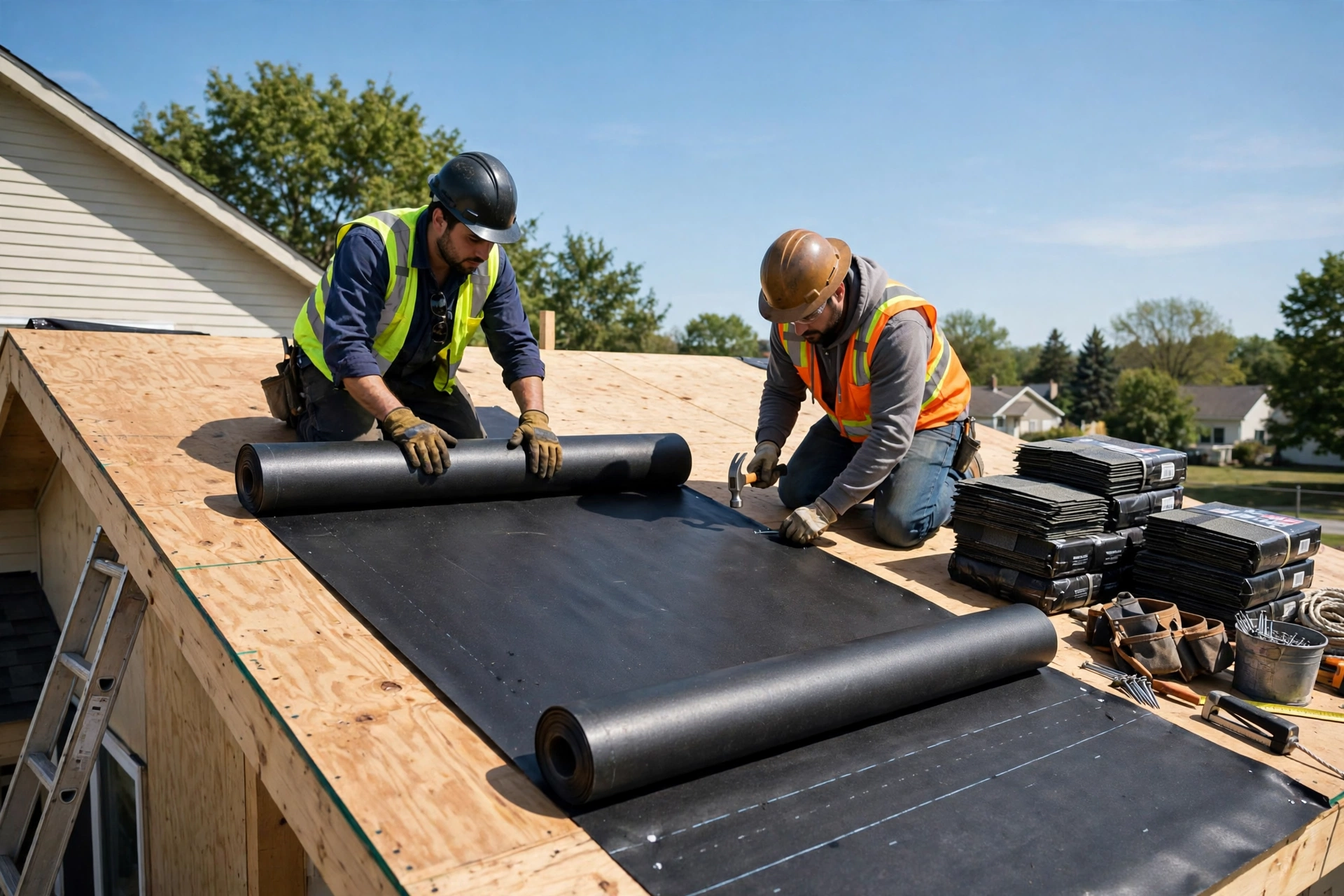
Synthetic underlayment is made from woven or spunbond polypropylene or polyethylene polymers, engineered specifically for roofing. It does not absorb water, so it stays flat and functional even if it gets rained on during installation. It is far stronger than felt, resisting tears from boots and tools, and most products carry 60 to 180 days of UV exposure tolerance, which removes the panic when a project schedule slips.
Synthetic is also lighter and covers more area per roll — typically 400 to 1,000 square feet compared with about 200 for felt — so installation is faster, with fewer seams and fewer trips up the ladder. Its service life of 25 to 40 years generally matches or outlasts the shingles above it. The cost per roll is higher, roughly 50 to 130 dollars against 20 to 30 dollars for felt, but per square foot of coverage the difference narrows considerably, and the added protection is worth the premium on nearly any roof that must survive real weather.
Self-Adhering Ice and Water Shield: Where Waterproofing Matters Most
Rubberized asphalt, sold as ice and water shield, is a self-adhesive membrane that bonds directly to the deck and creates a fully waterproof seal. It is the only underlayment type that seals around nail penetrations, which is something neither felt nor synthetic can do. That property makes it the right choice for the most vulnerable parts of any roof: the eaves, where ice dams form; valleys, where water concentrates; and around chimneys, skylights, and vent pipes.
In cold climates, building codes commonly require ice and water shield extending from the eave up past the interior wall line, because that is where ice dams push meltwater under the shingles. It costs more per square foot than any other underlayment, so full-roof coverage is usually reserved for low-slope roofs or storm-prone areas — but using it in the vulnerable zones is one of the highest-value upgrades in roofing.
Matching Roofing Underlayment to Your Roofing Material and Slope
The roofing material above the underlayment changes the requirements. Asphalt shingles, the most common residential choice, pair well with synthetic field underlayment plus ice and water shield at the edges. Metal roofing expands and contracts with temperature, so it needs an underlayment with high heat tolerance and a slip-resistant surface; some manufacturers specify a particular synthetic or a high-temperature ice and water shield. Tile and slate are heavy and long-lived, so the underlayment beneath them should last as long as the covering itself, which often points to premium synthetic or double-layer felt.
Roof slope matters just as much. On low-slope roofs, water drains slowly, so a fully adhered membrane or double coverage is often specified. On steep roofs, a slip-resistant synthetic with strong tear resistance is the safer pick. Always check the roofing manufacturer’s instructions, because using an unapproved underlayment can void the shingle warranty.
Climate and Weather: Picking Underlayment for Rain, Snow, and Heat
Hot, sunny climates punish underlayment with ultraviolet exposure and heat, so a synthetic with a strong UV rating is the sensible choice. Cold climates need ice and water shield at the eaves and valleys as a baseline, paired with synthetic across the rest of the deck, because freeze-thaw cycles open small gaps that only a self-sealing membrane can close.
- Wet and coastal climates — maximum water resistance is essential, which effectively rules out felt for the field of the roof.
- Wind-driven rain — hurricanes and coastal storms push water well up under shingles, so high-tear-strength synthetic with well-sealed laps is essential.
- Most exposed regions — a fully adhered membrane is worth considering where storms are severe.
In short, the harsher the weather your roof faces, the more the underlayment decision matters — and the less sense it makes to save money on the layer nobody sees.
Roofing Underlayment Costs: What a Typical Roof Should Budget
Underlayment is a small share of a roofing bill, which is precisely why upgrading it is good value. Felt materials typically run about 5 to 45 cents per square foot, synthetic about 15 to 70 cents per square foot, and ice and water shield considerably more, which is why it is used in strips rather than across the whole roof. On a typical 2,000-square-foot roof, moving from felt to synthetic might add a few hundred dollars to the material bill — a small fraction of a full re-roofing project.
Labor differences are modest. Synthetic installs faster because each roll covers more area and weighs less, which can partly offset the higher material price. The expensive mistake is choosing the cheapest underlayment, then paying for deck repairs or an early re-roof when it fails. Get itemized quotes that separate underlayment material from shingles and labor, so you can see exactly what the upgrade costs.
Roofing Underlayment Installation Errors That Shorten Roof Life
Even the best underlayment fails when it is installed carelessly. The most common error is insufficient overlap: laps that are too short let wind-driven rain slip between courses, and the problem stays hidden until the deck rots. Fasteners are the next weak point. Staples or nails driven through underlayment create holes, and on a low-slope roof those holes can leak; using the correct cap nails or plastic cap staples, spaced to the manufacturer’s instructions, keeps the membrane intact.
- Wrinkles and trapped moisture — felt that goes down wrinkled stays wrinkled, and shingles laid over it will never sit flat.
- Over-stretched synthetic — pulled too tight, it can draw away from laps as temperatures change.
- Cut valleys — underlayment should run continuously through a valley, never cut at its center line.
- Overexposure — never leave underlayment exposed beyond its rated UV window; tarp the roof or finish the shingles if the schedule slips.
When an Underlayment Problem Means Calling a Roofing Contractor
Some underlayment work belongs to professionals. If you can see daylight through the deck from the attic, if the sheathing feels soft or crumbles, or if stains and mold are spreading across the underside of the deck, the damage is already structural and needs a roofer’s assessment before anything is covered up. Ice dam damage that has soaked insulation and drywall is likewise beyond a DIY patch.
A licensed roofer can also tell you whether the existing underlayment is even worth keeping during a re-roof. In many cases the old felt is torn, brittle, or saturated, and stripping it to the deck is the only honest option. Roof work is also dangerous: steep pitches, wet surfaces, and heights combine into one of the riskiest DIY jobs in home improvement. If the job needs more than a small patch, get three written quotes from licensed, insured roofers and ask each one to specify the underlayment brand and type in the bid.
Final Thoughts: Choosing Roofing Underlayment That Outlasts Your Shingles
Roofing underlayment is invisible once the job is done, and that invisibility is the trap. It is the layer that carries your roof through the storm that lifts a shingle, the ice dam that backs water uphill, and the week of rain that delays the crew. For most homes, the right answer is synthetic underlayment across the field and ice and water shield at the eaves, valleys, and penetrations — a combination that costs a few hundred dollars more than felt and protects the roof for decades longer. Spend the money on the layer nobody sees, and the layer everybody sees will last longer too.
Roofing Underlayment Questions Homeowners Ask Before a Re-Roof
Can roofing underlayment be installed over old felt?
In most cases, no. Old felt is usually brittle, torn, or damp, and laying new underlayment over it traps moisture and hides deck damage. A proper re-roof strips the old underlayment so the deck can be inspected and repaired, then installs a fresh layer. Some local codes allow an overlay in narrow circumstances, but a full strip is the safer and more durable choice.
How long can synthetic underlayment stay exposed before shingles go on?
Most synthetic products are rated for 60 to 180 days of direct UV and weather exposure, depending on the brand. Check the product’s printed rating rather than assuming, and cover the roof with tarps if the schedule slips beyond it. Felt, by contrast, is generally rated for 30 days or less and degrades much faster in sun and rain.
Is ice and water shield required by building code?
In many cold-climate jurisdictions, yes — building codes commonly require an ice barrier extending from the eave up past the inside face of the exterior wall. Requirements vary by location and roof design, so confirm with your local building department or your roofer before the job starts rather than discovering the rule at inspection.
Does underlayment affect my shingle warranty?
It can. Many shingle manufacturers specify approved underlayment types, and using an unapproved product or installing it incorrectly can void the warranty on the shingles. Ask your roofer to confirm the underlayment is on the manufacturer’s approved list and keep the product documentation with your roofing paperwork.
What is the best underlayment for a metal roof?
Metal roofing needs an underlayment rated for high temperatures, because metal surfaces get far hotter than shingles in direct sun. A high-temperature synthetic or a high-temperature self-adhering membrane is the usual recommendation. Always follow the metal roofing manufacturer’s specification, since the wrong underlayment can melt, stick, or fail prematurely under a metal roof.
How do I know my existing underlayment has failed?
Look for water stains on the underside of the roof deck in the attic, damp or sagging insulation, mold on framing, and shingles that have curled or lifted without an obvious cause. Peeling paint on exterior walls near the eaves can also signal water getting past the underlayment. Any of these signs calls for a professional roof inspection.